Carbon figures your assurance provider can verify line by line
Every number in an Emissa report can be walked backwards to what produced it: the result, the replayable calculation, the factor and its version, the activity record and the source document.
From source document to report
A deterministic engine
The calculation engine is deterministic and version-stamped, so a trace can be replayed and gives the same answer.
Append-only results
Recalculation supersedes an earlier result — it never overwrites history.
Hash-chained audit trail
Every insert, update and delete writes a tamper-evident audit event — who, what, before and after, chained by hash.
Factors are data, never code
Conversion factors only exist inside versioned datasets. Nothing is hard-coded, nothing is invented.
Locked periods stay locked
Reported periods reject silent changes — corrections go through restatements with a recorded explanation.
A read-only Auditor role
Role-based access down to individual pages, so an auditor can look without being able to change anything.
Official Defra conversion factors, versioned by year
Emissa uses the official UK Government (Defra) greenhouse gas conversion factors. Each annual gov.uk release is imported automatically as a versioned dataset and applies to activity dated in its own year — publishing a new release never changes an existing figure.
Reports state the calculation engine version and the checksums of the factor sets used, so the figures in a report can be tied to the exact datasets behind them. A country's published electricity factor can be added once, with its source, for sites outside the UK.
The uncertain parts, clearly marked
Estimates with the working on every line
- Estimates are flagged as estimates, with a data quality score, so auditors can find them and you can replace them when real data arrives.
- Assumptions carry their source. A model's assumptions, where they come from and the arithmetic are written onto every line it produces.
- A person confirms every AI suggestion. Emissa AI proposes an entry with its reasoning and confidence; nothing enters the ledger until someone accepts it.
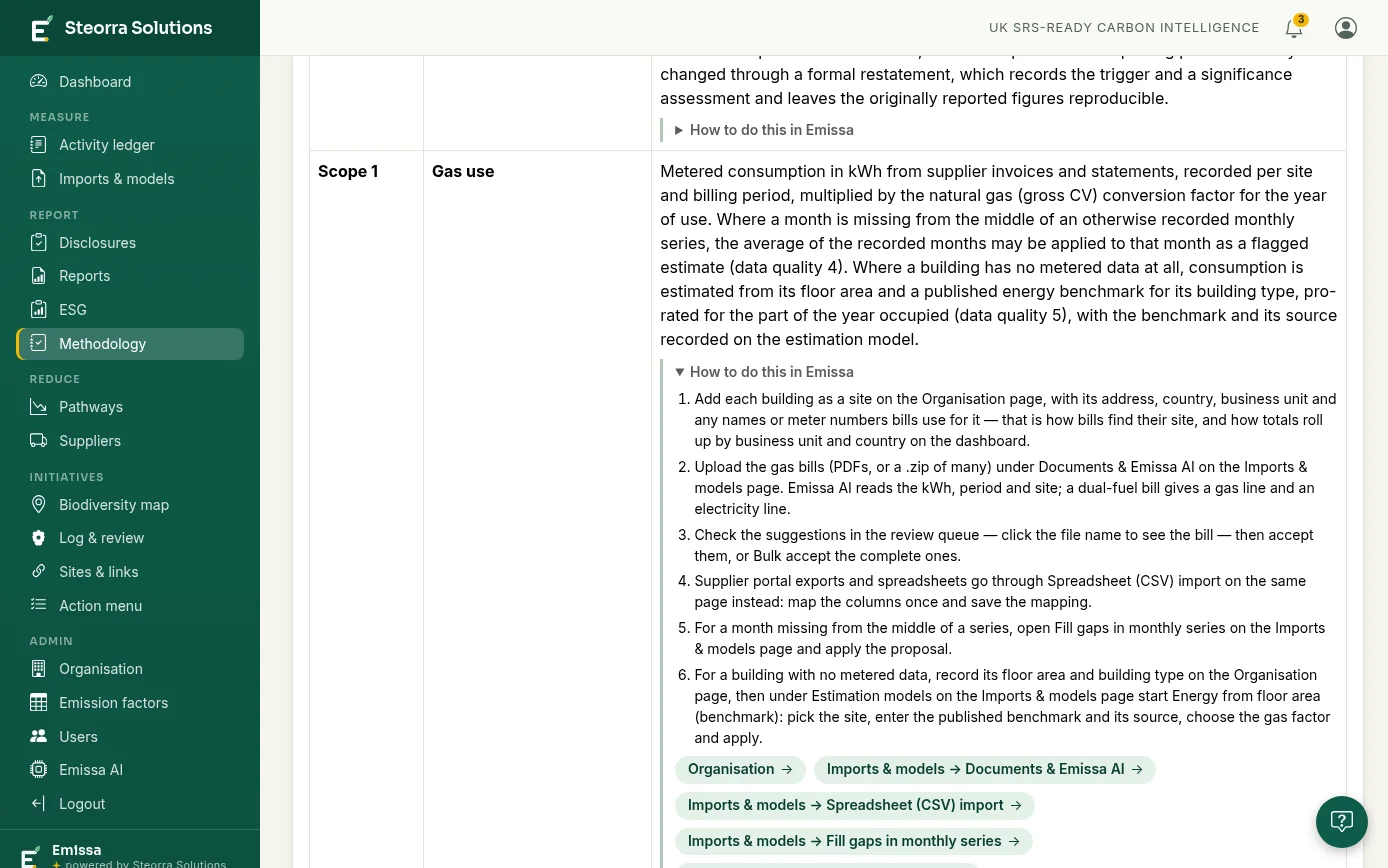
- The method is written down. The methodology statement is versioned on every save and printed inside the disclosure report.
Everything an auditor asks for, in one zip
The audit pack contains every figure, every calculation trace and every factor version for the period — alongside branded PDF and Word reports that state the methodology, the engine version and the factor-set checksums.
Evidence stays attached
Bills, invoices and exports are kept with the ledger lines they produced.
Signed, scanned releases
Signed container images with a software bill of materials, and dependency and vulnerability scanning in CI.
Your own isolated stack
A dedicated database, storage and queues per client — not a shared database with a customer column.
Common questions
Can an assurance provider verify the figures?
Yes. Every number in a report can be walked back to its result, calculation trace, factor version and source document. The audit pack puts every figure, every calculation trace and every factor version in one zip.
What happens when a figure is recalculated?
Results are append-only. A recalculation supersedes the earlier result — it never overwrites it — so the history of every figure is kept.
What happens when new emission factors are published?
Each annual UK Government release is imported as a new versioned dataset and applies to activity dated in its own year. Publishing a new release never changes an existing figure.
Can a reported period be changed afterwards?
Not silently. Reported periods are locked, and corrections go through a restatement with a recorded explanation.
Can an auditor have their own access?
Yes. Access is role-based down to individual pages, and includes a read-only Auditor role.
How are AI-extracted figures controlled?
Emissa AI proposes a ledger entry with its reasoning and confidence, but nothing enters the ledger until a person confirms it.
More of the platform
Scope 1 and 2 emissions
Gas, fuel, refrigerant and electricity bills turned into ledger lines, with Scope 2 both location- and market-based.
Scope 3 emissions
All fifteen categories, from supplier data, spend, travel and surveys — with the working on every line.
UK SRS reporting
A disclosure workbook on the four pillars, filled from the ledger, with reports and an audit pack.
Defra conversion factors
Each annual gov.uk release imported automatically and applied to activity dated in its own year.
Biodiversity initiatives
Site-by-site actions on one map, linked into pollinator highways and reported by client or region.
The whole platform
Measure, report and reduce: how the ledger, the methodology statement and the models fit together.
See it with your own data
A demo takes half an hour — bring a handful of real bills and watch them become an auditable ledger.
Book a demo