UK SRS reporting from the ledger you already keep
Emissa organises sustainability disclosure the way UK SRS S1 and S2 do — governance, strategy, risk management, metrics and targets — and fills the metrics from an auditable emissions ledger. Where the rules are not final, the product says so.
Draft-aligned, and honest about it
UK SRS S1 and S2 are the UK Sustainability Reporting Standards, based on IFRS S1 and S2. The final FCA/DBT rules are still pending, so Emissa's disclosure workbook is a draft-aligned template structured on the public IFRS S1/S2 four-pillar framework — and a visible warning in the product says exactly that. The government's own UK SRS guidance is on gov.uk.
The mapping of requirements is versioned configuration, not code. When the official mapping is published it replaces the template by configuration, not by release — and Emissa never fills the gap with invented regulatory text.
A disclosure workbook, not a blank page
Every requirement is a task. The four pillars give the structure; your team supplies the owner, the evidence and the words.
Governance
Requirements on oversight and responsibilities, each with an owner, a status, evidence and narrative.
Strategy
Requirements on risks, opportunities and plans — with decarbonisation pathways charted from your own ledger to draw on.
Risk management
Requirements on how sustainability risks are identified, assessed and managed.
Metrics & targets
Emissions by scope and category straight from the ledger, with Scope 2 shown both location- and market-based, and targets tracked against actuals.
Status you can see
Each requirement moves from not started to in progress, in review and complete — or is marked not applicable.
Reliefs recorded, not hidden
Relief elections and their justifications are recorded and feed the compliance statement in the report.
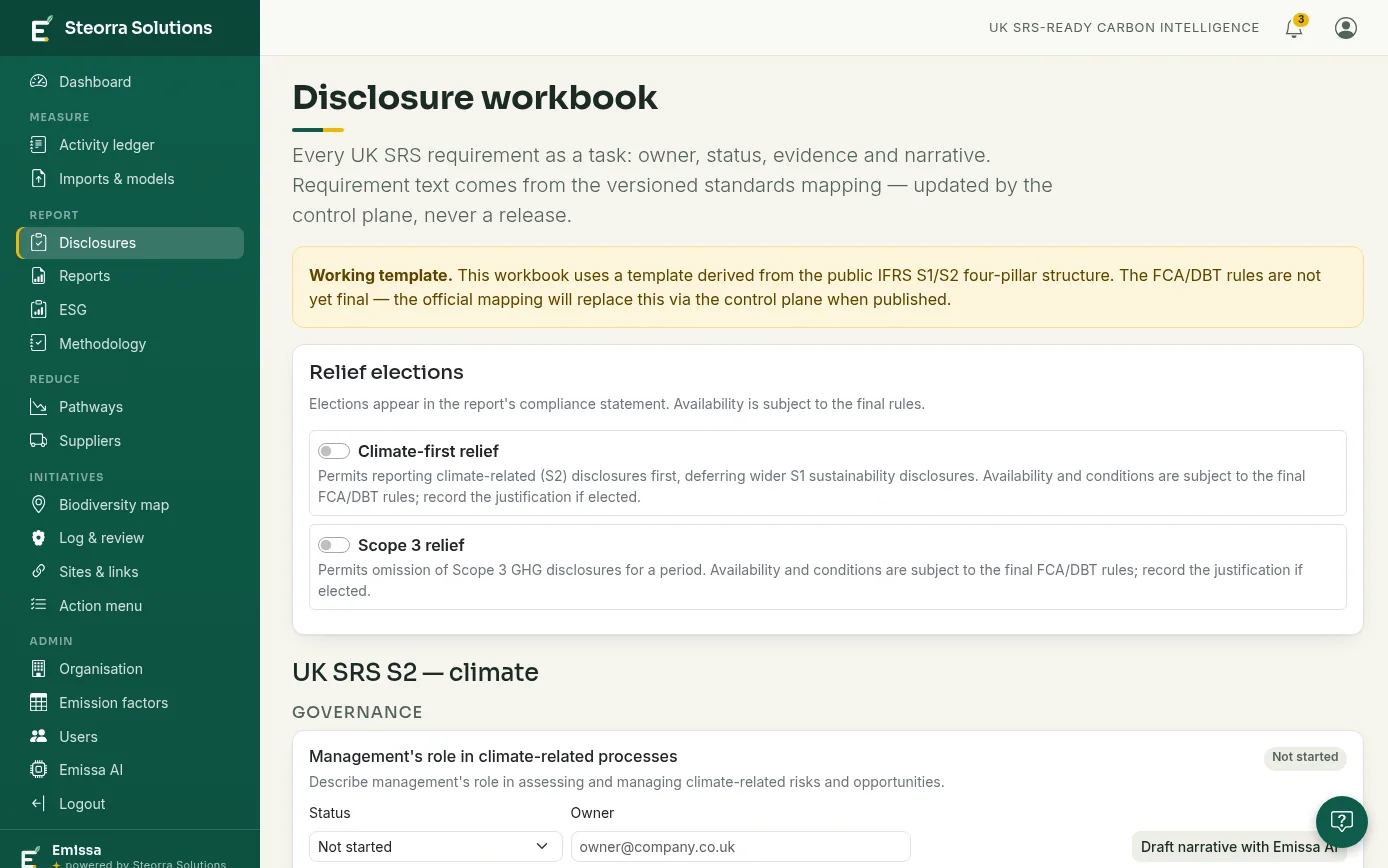
The workbook, as your team sees it
- Reliefs are elected in the workbook, and each election appears in the report's compliance statement.
- Requirement text comes from the versioned mapping — updated by configuration, never by a release.
- A notice at the top says the template is not final while the FCA/DBT rules are pending.
Reports an assurance provider can check
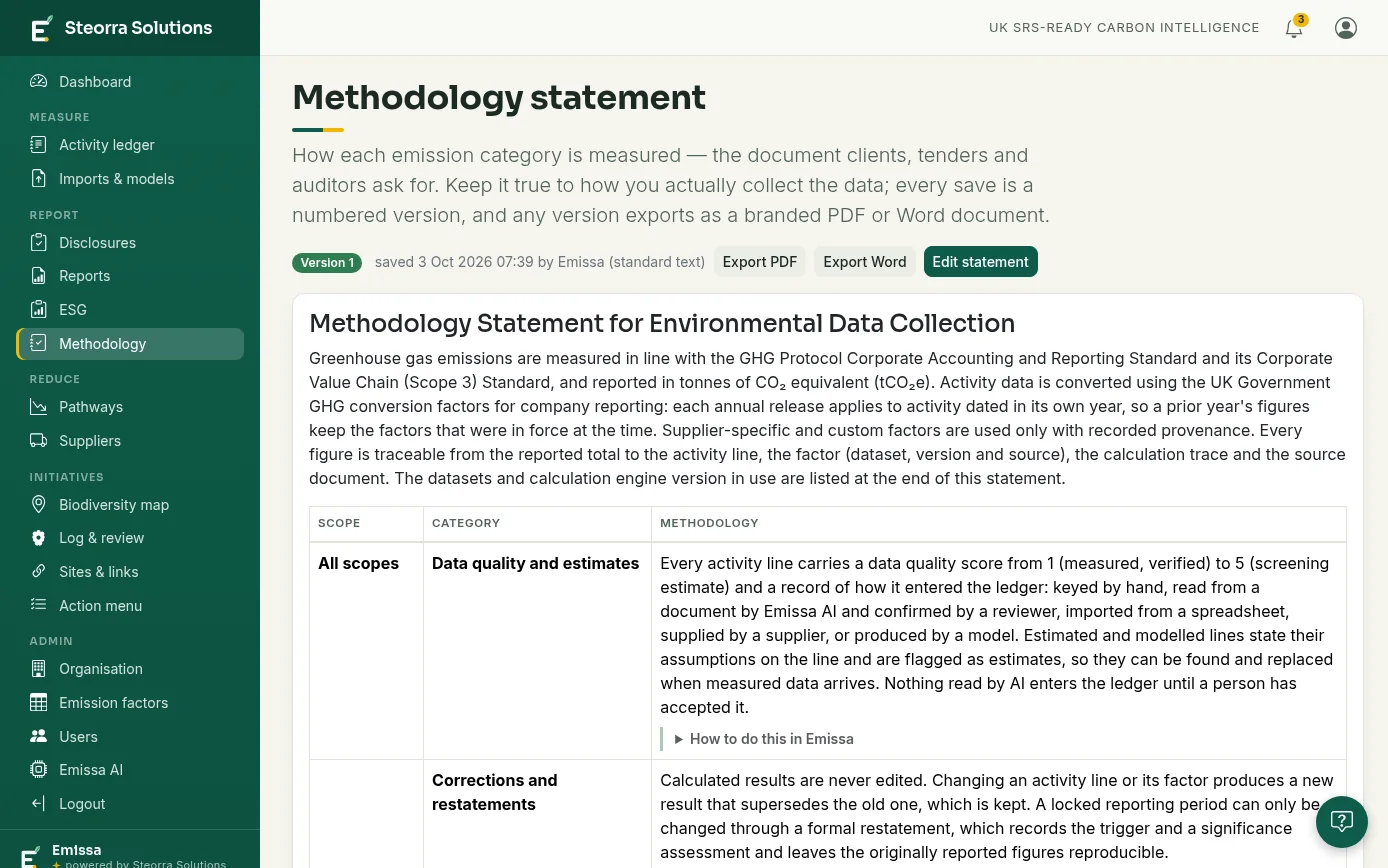
Branded PDF and Word, with the method stated
- The methodology statement is printed inside the report, along with the calculation engine version and the checksums of the factor sets used.
- Versioned on every save. The statement is written in the product, any version can be restored or exported, and the report always prints the current one.
- An audit pack in one zip: every figure, every calculation trace and every factor version.
- Locked periods stay locked. Corrections to a reported period go through a restatement with a recorded explanation.
Enter data once, answer everyone
The ledger follows the GHG Protocol — all three scopes, all fifteen Scope 3 categories, Scope 2 dual reporting. Disclosure requirements cross-reference adjacent frameworks so the same data answers more than one question.
Pathway checks against the SBTi rate are a configurable criterion, not an SBTi validation.
Common questions
Is Emissa's UK SRS mapping final?
No, and Emissa says so in the product. The workbook is a draft-aligned template structured on the public IFRS S1/S2 four-pillar framework while the final FCA/DBT rules are pending. The official mapping replaces the template by configuration the day it is published.
What happens when the final rules are published?
The mapping of requirements is versioned configuration data, not code. It is updated without a software release, and the work you have already recorded against each requirement stays in your workbook.
Can reliefs be recorded?
Yes. Relief elections are recorded with their justification — recorded, not hidden — and feed the compliance statement in the report.
Does the same data answer other frameworks?
Disclosure requirements cross-reference SECR, TCFD, CSRD/ESRS and CDP, so data entered once answers more than one question. The ledger itself follows the GHG Protocol, with Scope 2 reported both location-based and market-based.
Does Emissa AI write the disclosures?
Emissa AI can draft a narrative from your own figures, but a draft is never used in a report directly: it waits beside the approved text until a person reviews and promotes it.
More of the platform
Scope 1 and 2 emissions
Gas, fuel, refrigerant and electricity bills turned into ledger lines, with Scope 2 both location- and market-based.
Scope 3 emissions
All fifteen categories, from supplier data, spend, travel and surveys — with the working on every line.
Defra conversion factors
Each annual gov.uk release imported automatically and applied to activity dated in its own year.
Carbon audit trail
Every figure walked back to its factor version, calculation trace and source document.
Biodiversity initiatives
Site-by-site actions on one map, linked into pollinator highways and reported by client or region.
The whole platform
Measure, report and reduce: how the ledger, the methodology statement and the models fit together.
See it with your own data
A demo takes half an hour — bring a handful of real bills and watch them become an auditable ledger.
Book a demo